Manufacturing staff survey questions, by issue
The questions are where it starts: they show you where to act. Each group below begins with what research on manufacturing has found, says what the questions help you see and how to track them, then gives the questions in a box. Statements are answered on a scale from strongly disagree to strongly agree.
The first question in each box is the core question for that issue. Keep it the same from one survey to the next: research on measuring change over time shows that comparisons only hold when the question stays the same. Use the rest as they are, add your own, or ask us: we work with you to fine-tune your questions.
Safety · Speaking up and being heard
Will people speak up about safety before someone is hurt?
Manufacturing's fatal injury rate is about 1.5 times the rate across all industries, and workers' sense of management's commitment to safety is the most robust predictor of injuries. In a study across five high-risk industries, about 2.5 accidents went unreported for every one that was reported, and more where supervisors enforced safety inconsistently.
What it helps you see: how safe people feel, whether near misses and minor injuries get reported, and whether output ever comes before safety, line by line and shift by shift.
Questions to ask
- I feel safe at work.
- I report near misses because I know they will be acted on.
- Production targets never come before safety here.
- I feel able to stop a job I think is unsafe.
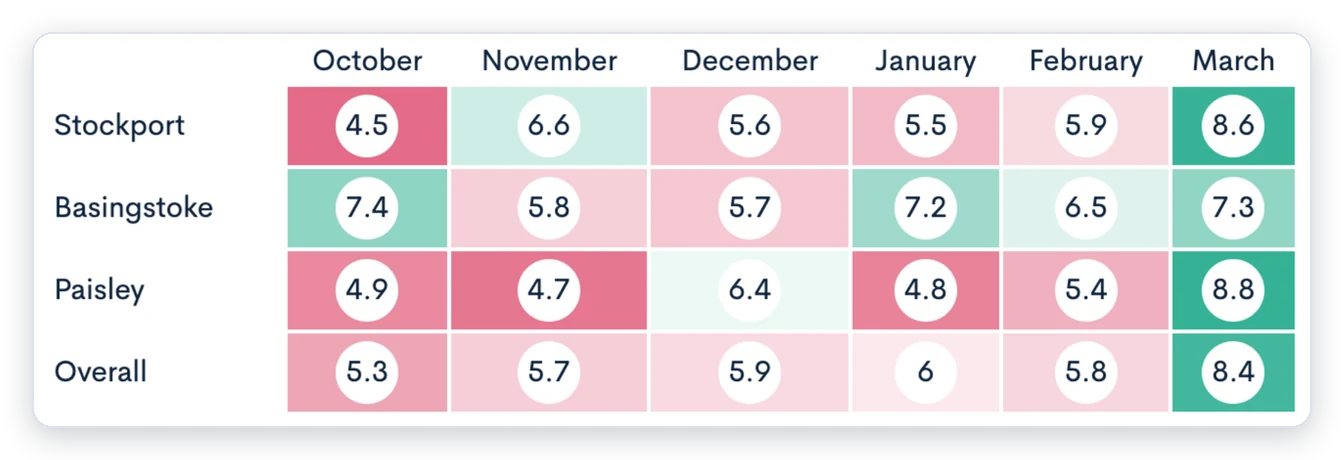
How to track it: ask in a short pulse survey each quarter, split by line and shift, so that each team leader sees their own team's results.
Management and support
Are team leaders setting the tone, on safety and on support?
In a factory study, giving line supervisors regular feedback on how often they raised safety with their teams led to fewer minor injuries and better safety climate scores. In another study, of 53 work groups at a manufacturing company, how each group saw its own supervisor's safety practices predicted its minor injuries over the next five months.
What it helps you see: which teams have leaders who make expectations clear, talk about safety as well as output, and give people useful feedback.
Questions to ask
- My manager supports me when I need it.
- My team leader explains clearly what's expected of us each shift.
- My team leader talks to us about safety, not just output.
- I get useful feedback on how I'm doing.
How to track it: share each team's results with its team leader, with the ethics filter on so results are only shown for groups of six or more, and bring them into one-to-ones.
Shift work and fatigue
How are shift patterns affecting people?
Safety declines over successive night shifts, with longer hours on duty and with longer gaps between breaks. A meta-analysis of 21 studies found that shift workers had a 17% higher risk of cardiovascular disease.
What it helps you see: whether rotas leave people rested, whether breaks happen when the line is behind, and whether nights get the same support as days.
Questions to ask
- My hours and rota let me get enough rest between shifts.
- My shift pattern lets me get enough sleep.
- I can take my breaks, even when we're behind.
- The night shift gets the same support as the day shift.
How to track it: ask before and after a change to shift patterns, and compare nights with days on one dashboard.
Training and progression
Is know-how being passed on before people retire?
With more of your workforce over 50 than in other industries, much of what matters most is in experienced people's heads. Ask whether it is being passed on, and whether newer people can see a future with you.
What it helps you see: whether people are getting the training they need, whether experienced staff have time to pass on what they know, and whether people can see a way to progress.
Questions to ask
- I have had the training I need to do my job well.
- I have chances to learn new skills or work on new machines.
- Experienced colleagues have time to pass on what they know.
- I can see a way to progress here.
How to track it: ask once a year in your fuller survey, split by age group and length of service, and follow apprentices and new starters with an onboarding journey.
Speaking up and being heard
Are ideas from the shop floor heard?
Psychological safety, the sense that it is safe to speak up in your team, was first shown to drive team learning in a study of 51 teams at a manufacturing company, and a review of lean found that it can harm the working environment in simple manual work unless employees are involved.
What it helps you see: whether people feel safe to raise problems and ideas, and whether they hear what came of them, especially during lean or continuous-improvement changes.
Questions to ask
- I feel able to raise a concern without worrying about what happens next.
- My ideas for doing things better are listened to.
- I hear what happened to ideas or concerns I raised.
- What one change would make your job easier or safer?
How to track it: ask during and after a lean or continuous-improvement change, and show each team what came of its ideas.
Turnover and retention · Burnout and wellbeing
Who is planning to leave, and what is wearing them down?
Around 101,000 manufacturing workers have work-related ill health, and stress, depression or anxiety make up 43% of cases and musculoskeletal disorders 37%. Thinking about leaving is the strongest single predictor of actually leaving, which makes it worth asking directly.
What it helps you see: who is thinking of leaving, by site, role and shift, and whether stress or the physical demands of the job are behind it.
Questions to ask
- I see myself still working here in a year's time.
- I have enough energy left for life outside work.
- The physical demands of my job are manageable.
- What would make you more likely to stay?
How to track it: ask the core questions in every survey, ask leavers why they went with an exit survey, and compare sites and shifts.